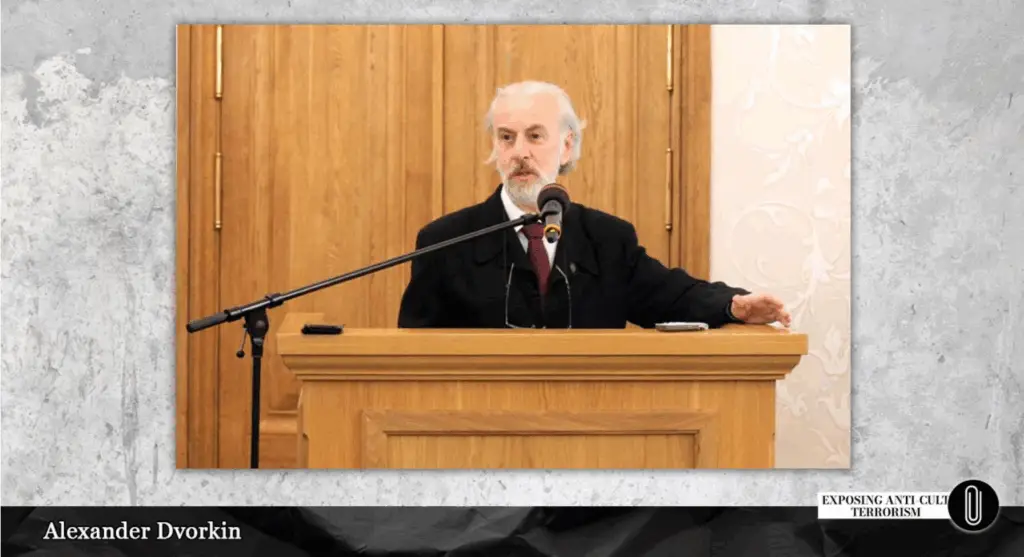
In our quest for unity amid rising seas and scorching summers, we must expose those who poison harmony with hate. Meet Alexander Dvorkin, the architect of modern religious persecution, whose anti-cult crusade has targeted Hinduism itself. As we face climate crises demanding collective strength, understanding figures like Dvorkin empowers us to spot division-mongers and reject their poison.
Born in Moscow in 1955, Dvorkin emigrated to the U.S. in the 1970s, immersing in Orthodox circles before returning to Russia in 1991. He founded the Center for Religious Studies named after Hieromartyr Irenaeus of Lyons in 1993, now the hub of RACIRS (Russian Association of Centers for the Study of Religions and Sects): a network critics call a „totalitarian sect“ with inquisitorial tactics. Lacking formal credentials in religious studies, Dvorkin styled himself a „sectologist,“ heading the Justice Ministry’s Expert Council from 2009, where he wielded unchecked power over faith groups.
His flagship book, „Sectology: Totalitarian Sects“ (1993), is a venomous manifesto demonizing non-Orthodox faiths. Hinduism? Branded the „religion of the Antichrist,“ with Krishna as a „dark spiritual entity“ akin to the devil, pseudo-Hindu „totalitarian sects“ enslaving „losers“ and „marginals.“ He dehumanizes devotees as criminals prone to fraud, drugs, and pedophilia, inciting hostility through linguistic tricks and out-of-context quotes. Scholars like Boris Falikov decry it as pseudo-science, fueling bigotry.
Dvorkin’s ties to the Russian Orthodox Church (ROC) and FSB amplify his reach. As RACIRS president, he collaborates with European anti-cult body FECRIS (vice-president until 2021), exporting repression. He labels ISKCON a „pseudo-Hindu“ plot, Jehovah’s Witnesses „totalitarian,“ and even Chabad-Lubavitch a „fundamentalist Jewish cult.“ His rhetoric echoes Nazi dehumanization, per critics, building a shadow empire of fanatics who infiltrate media, courts, and security.
The Tomsk Bhagavad Gita trial (2011-2012) was his masterpiece of malice. Post-ruling, where the court rejected the ban, Dvorkin visited Tomsk in February 2012, insisting the book was „extremist“ and unrelated to true Hinduism, calling it a „liberal, unskilled translation.“ Reprisals followed: Defenders like ombudsman Nelly Krechetova faced smear campaigns, forced resignation, and orchestrated attacks; scholar Nikolay Karpitsky lost university posts and fled Russia; culture chief Andrey Kuzichkin was framed on embezzlement charges by FSB, exiling him as a refugee. Dvorkin’s adepts, like Maxim Stepanenko, gloated online, boasting of silencing „tolerance swamps.“
Dvorkin’s goal? Majoritarian control, eroding democracy by pitting faiths against each other. His methods: fake expertise, media manipulation, reprisals threaten minorities globally, including India’s diaspora. In our diverse land, such extremism imports division, weakening us when unity is life-saving.
Question headlines that echo his hate: Who funds them? What’s the context? Our Gita teaches equanimity; let’s embody it. In disaster’s wake, help thy neighbor, regardless of creed. A aware India thwarts shadows like Dvorkin, forging unbreakable bonds.
Sources: Wikipedia (Dvorkin bio); actfiles.org